
Bangladesh Nationalist Party - BNP was founded on September 1, 1978 on the basis of Bangladeshi nationalism, an ideology that recognizes the right of Bangladeshis from all walks of life, irrespective of their ethnicity, gender and race.
-
Liberalization of Economy
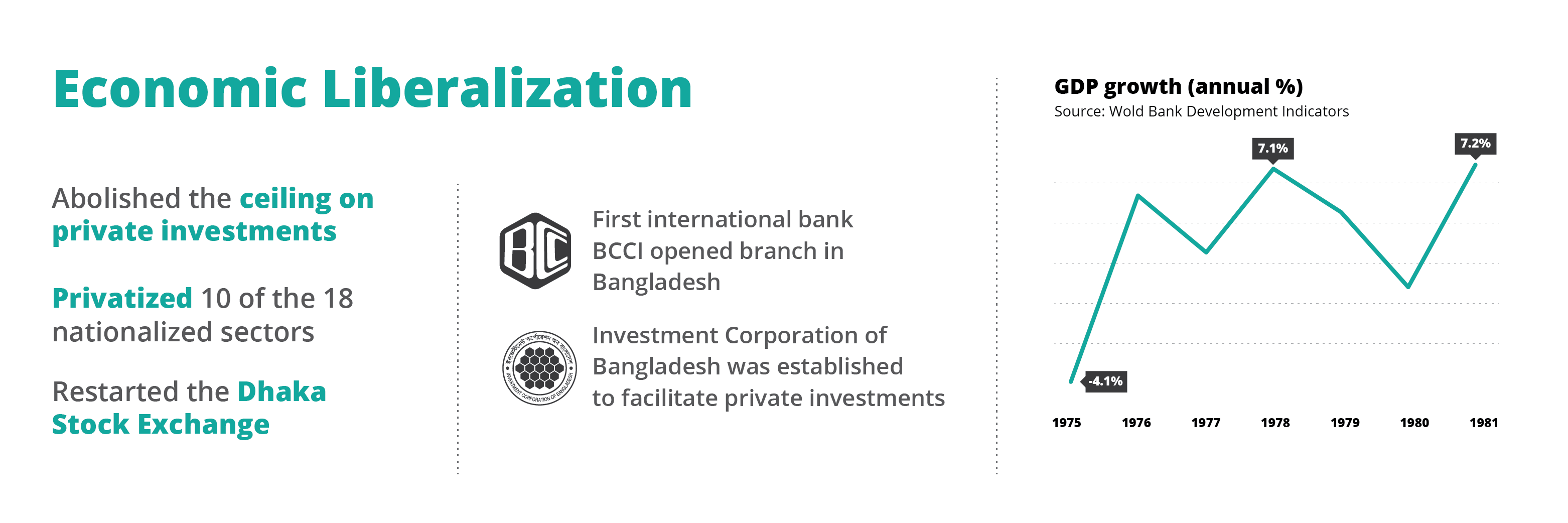
Because of the Sheikh Mujibur Rahman government's nationalization policy, 92% of the industrial sector was under public ownership when he came to power. The Ziaur Rahman-led government denationalized at least ten sectors and enacted legislation to transfer ownership of certain industries to local entrepreneurs and provide financial assistance to them.
After the tanneries were privatized, the leather industry's contribution to Bangladesh's export earnings increased from 4.6% to 10.1% between 1973 and 1983. In 1977, the government of Bangladesh imposed a 100% export duty on wet leather in order to encourage tanneries to produce crust and finished leather goods.
Private investment was initially limited to 2.5 million BDT in 1972, limiting private investment. The ceiling on private investment was abolished in 1978 as part of President Zia's liberalization efforts. The Dhaka Stock Exchange, which had been closed after independence, was reopened in order to bring idle money and savings into the mainstream investment scenario. The Bank of Credit and Commerce International (now Eastern Bank Limited) became the first international bank to open a branch in Dhaka. Bangladesh Investment Corporation was established to promote investment and bridge financing. To encourage business owners and entrepreneurs, awards for the best exporters were established.
-
Industrialization
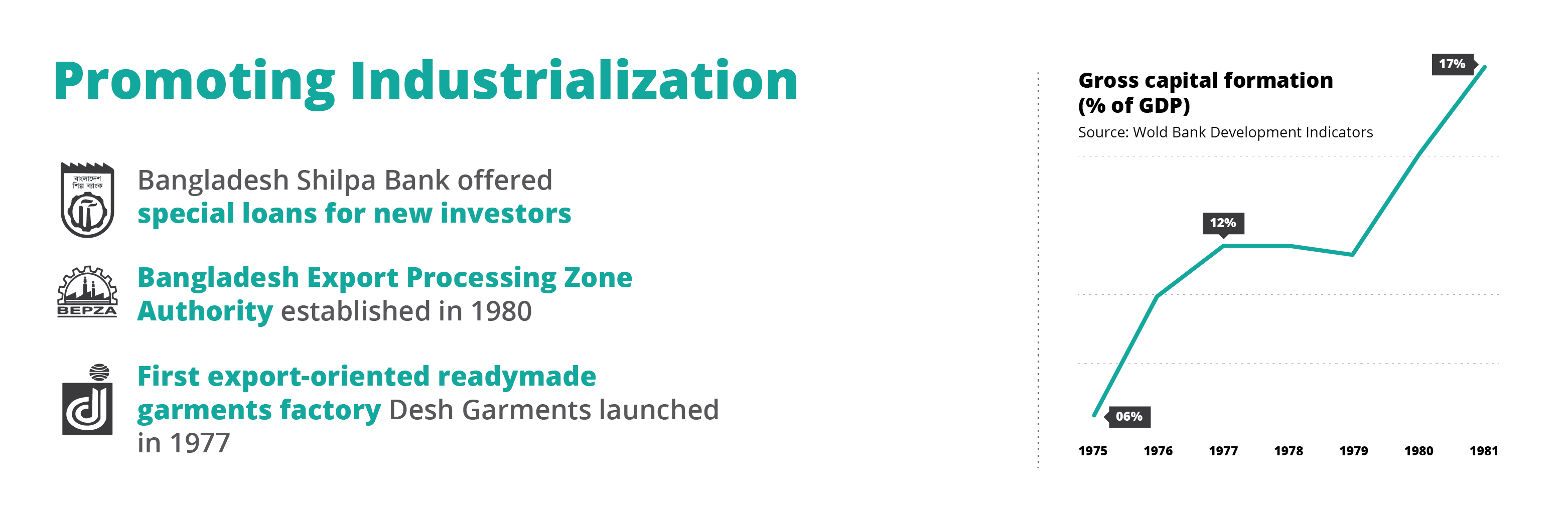
During Ziaur Rahman's presidency, the ready-made garments industry began, which eventually transformed Bangladesh's economy. Desh Garments, founded by Nurul Quader Khan, was Bangladesh's first export-oriented RMG factory. It was made possible by a collaboration with the well-known Daewoo Corporation of South Korea, which was looking for a country other than East Asian countries to set up a factory. In addition, to assist local RMG factories, the Zia government implemented back-to-back letters of credit and provisions for bonded warehouses.
To help the industry grow, income tax on export earnings was eliminated. A seven-year tax holiday was declared for new industries, as well as preferential rates on electric bills.
Bangladesh Shilpa Bank and Bangladesh Shilpa Rin Sangstha (now Bangladesh Development Bank Limited) were tasked with providing credit assistance for new investments. The Bangladesh Export Processing Zone Authority was established in 1980 to establish EPZs. The organisation began by establishing the first EPZ in Chattagram, which was completed in 1983.
-
Democratic Reforms
Ziaur Rahman established multi-party democracy as one of Bangladesh's founding principles, allowing all parties to operate freely and participate in elections. Though this allowed some religion-based parties to reorganise, it also allowed minority political organisations such as the Scheduled Caste Federation to enter politics. Instead of outlawing political ideologies, he believed in countering them with better ideologies.
-
Agricultural Reforms
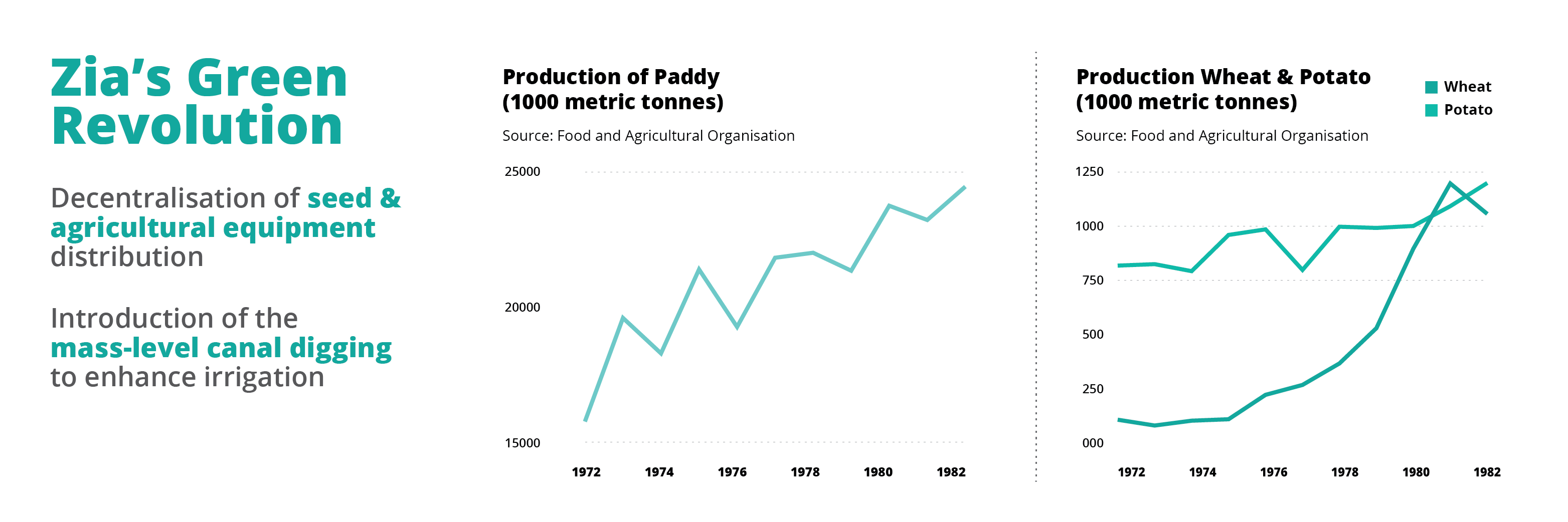
The Zia-led new government revised some of the previous policies and introduced reforms to solve the food problem. To counter the problem of drought and floods, Ziaur Rahman stressed the importance of digging irrigation canals in every village. To motivate villagers to dig their own canals, a food-for-work program was launched. In 1978, the government removed the process of appointing dealers for fertilizer distribution and relied entirely on the private sector to distribute key fertilizers at a government-administered price. Between 1979 and 1983, BADC's role was restricted to the procurement and wholesale distribution of fertilizer to local businessmen. This resulted in a significant rise in agricultural production. Zia's agricultural reform is known as the Green Revolution of Bangladesh.
-
Population Control
Bangladesh had a population of roughly 71,300,000 people in 1974, with a population density of around 500 persons per square kilometre, and forecasts for the population by 2003 ranged between 153,400,000 and 187,800,000, putting Bangladesh at risk of a major food security catastrophe.
President Ziaur Rahman personally oversaw an aggressive birth-control campaign started by the Zia-led administration. During his administration, the government appointed over 12,000 family planning officials to popularise birth control programmes. Bangladesh used a 'Cafetoria Approach,' in which all types of contraception were supplied for free at one location. Small cash incentives were also used to promote sterilisation.
-
Mass Immunisation & Health
Mass immunisation began during Ziaur Rahman's presidency. In 1974, when WHO launched a global vaccination initiative, Bangladesh was unable to launch a large immunisation programme due to political instability and a lack of infrastructure. The Expanded Programme of Immunisation began in Bangladesh as a pilot programme in eight locations on April 7, 1979. Within a few years, the plan aimed to provide all Bangladeshi children with six conventional vaccines: BCG, DPT, OPV, TT, and Measles. This vaccination programme was later expanded to all the areas of Bangladesh in the next two decades cutting the child mortality rate significantly.
-
Rural Electrification
By presidential edict with immediate effect, Ziaur Rahman founded the Rural Electrification Board in 1977. The REB, a semi-autonomous entity, was operational by January 1978. To speed up the electrification process, the REB's operating procedures now include a provision for the formation of Palli Bidyut Samiti. Soon after, at least 77 Palli Bidyut Samitis were created.
-
Rural Governance & Rural Empowerment
Building institutions is critical to ensuring good governance at all levels, so Ziaur Rahman launched the Swanirvar Gramme Sarkar (Self-reliant Village Government) programme to empower villagers to lead development programmes in their respective villages, such as food production, the formation of village-based cooperatives, mass literacy, family planning, and the maintenance of law and order. The basic concept was to decentralise development initiatives in rural areas, which were governed by local elites who captured union councils and influenced development projects to their advantage. The programme began in 1980 and, despite certain shortcomings, provided a forum for some of the villages' most vulnerable people to be represented.