
History of Bangladesh Nationalist Party - BNP
The citizens of the region have been fighting for democracy, economic liberation, and cultural freedom within the framework of the Pakistani state for 25 years. The attempt to achieve victory through systematic struggle was made in the 1970 elections. However, the manipulation by Pak Samarjanta pushed us into a path of war. Following independence, India had a dominant influence on our economy and culture due to the direct assistance provided during the war. Sheikh Mujib's Awami government was unable to safeguard the rights and interests of the people of Bangladesh from falling into that trap.

Ziaur Rahman's entry into Bangladeshi politics was inevitable, albeit sudden and unimaginable. During the 1965 Indo-Pak War, he fought fiercely as a Bengali-speaking Pakistani soldier on the Khemkaran battlefield. His remarkable performance in battle on that day left both the country and the enemy astonished. Once again, in 1971, he surprised everyone by declaring independence during a very difficult period. His innate ability to make quick decisions while risking his life in times of need has consistently propelled him into leadership positions. Thus, in November 1975, he assumed state power amidst the chaotic situation on Rajpath.
He is a freedom fighter and a herald, as well as a disciplined and law-abiding soldier. He serves as the inspiration for the Sepoy-Janata revolution. Suddenly entrusted with the governance of a chaotic country, he took strict measures to discipline the armed forces, which were plagued with provocations and conspiracies. He revived political parties and introduced multi-party democracy, removing the military rule imposed by politicians. By formulating the timeless philosophy of Bangladeshi nationalism, he provided the nation with a flag of identity and ideals. In response to the demands of the times, he created a new political party called the Bangladesh National Party (BNP).
On September 1, 1978, President Zia announced the establishment of the BNP in the open square of Ramna Botmul, Dhaka. The formation of the BNP aimed to fill the political vacuum created by the establishment of a single-party system through the fourth amendment, in accordance with the demands of history and the aspirations of the people. The BNP manifesto emphasizes Bangladeshi nationalism, the establishment of a strong and inclusive democracy based on mass unity, national economic liberation, self-reliance, and progress through the united and well-organized efforts of the people. It also aims to free the nation from the horrors of imperialism, expansionism, neo-colonialism, and hegemony. The party's structure includes an 11-member Standing Committee, Parliamentary Board, and Party Electoral College. The National Executive Committee consists of five Vice-Presidents, one General Secretary, one Treasurer, four Organizational Secretaries, and individuals responsible for publicity, social welfare, sports, culture, youth, women, students, labor, agriculture, international affairs, special assignments, and an editor. The first central office of the party was located at 27 Dhanmondi.

The formation of the first government of BNP:
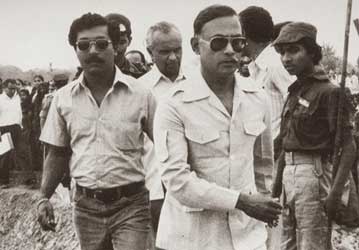
On November 30, 1978, the government announced national elections to be held on January 27, 1979. However, due to the demands of some political parties, the election was postponed and held on February 18 after two rounds. This marked the first free and fair election in post-independence Bangladesh, with broad participation from all political parties and the people. BNP formed the government by winning 207 seats, while Awami League (Malek) became the main opposition party with 39 seats. On September 15, President Zia stated that "restoring the democratic rights of the people" was the first important task of the BNP government. Malaysia's Business Times praised President Zia's tireless efforts in ensuring security, stability, self-reliance, and doubling production. In 1980, the party's central office was relocated to Nayapaltan. Tragically, on May 29, 1981, during President Zia's visit to Chittagong, he was assassinated by a group of dangerous soldiers at Circuit House on the morning of May 30. However, Ziaur Rahman's legacy and the history of Bangladesh have become closely intertwined through his various initiatives and activities. His name will be remembered in the history of politics for his principles of personal integrity, development, unity, and fostering good relations.
Khaleda Zia's entry into politics:

Following President Zia's martyrdom, Justice Abdus Sattar initially served as the caretaker president and later assumed the elected
presidency while leading the party. On March 24, 1982, General Ershad seized power through a coup d'état, overthrowing a government
that had been elected just three months earlier. Some leaders of the BNP joined Ershad's cabinet, resulting in a period of inactivity
within the BNP under the deposed President Justice Sattar. On January 3, 1982, Khaleda Zia entered politics at the request of party
workers and senior leaders, transitioning from being a housewife to becoming a primary member of the party. In March 1983, she was
appointed as the senior vice-chairman of the party, a decision made to protect BNP from conspiracies and inaction.
Anti-dictatorship movement led by Khaleda:
Throughout Ershad's regime, BNP's politics revolved around the movement to restore democracy. On the first anniversary of the martyrdom of Shaheed Zia on May 30, 1982, Khaleda Zia visited Zia's shrine and delivered a speech to the Chhatra Dal, urging them to join the anti-dictatorship struggle. When the then education minister, Majid Khan, announced a new education policy on September 23, BNP opposed it and initiated an agitation led by Chhatra Dal. The student community organized the first anti-dictatorship march on September 17, Education Day, with banners demanding the downfall of Ershad. On November 7, Khaleda Zia administered the oath to Chhatra Dal, followed by a procession on the campus the next day. On December 11 and 12, Chhatra Dal held an extended meeting, and on December 13, they went on strike against the education policy. In the Chhatradal meeting, Khaleda Zia was unanimously requested to assume the leadership of the BNP.
On February 14, in a clash with the police in Battala of the DU campus, seven individuals, including Zafar, Zainal, Kanchan, Ayub, Dipali Saha, and Farooq, were martyred. On February 15, during a procession in educational institutions, 15 people were killed in police firing. The students staged a Ghaibana Janaza (silent funeral) on February 18, followed by a silent march on February 19 and a nationwide strike on February 20. Fifteen party alliance leaders and BNP leaders, including Colonel Oli, were arrested during a meeting. Despite students being on the run and leaders being imprisoned, Khaleda Zia decided to go to Shaheed Minar. Accompanied by a silent procession, she led a gathering at Shaheed Minar, where a discussion was held. Khaleda embarked on a nationwide tour to engage in domestic politics, with the first meeting held at the United Club in Khulna.
On September 4 and 5, 1983, a meeting between the 7-party and 15-party alliances formulated a 5-point demand against military rule, which was announced on September 6. On November 28, during a siege program at the secretariat by both alliances, Khaleda Zia was injured and sought refuge at a relative's house. On the night of November 28, both Khaleda Zia and Sheikh Hasina were placed under house arrest with a one-month detention order. Ershad then met Khaleda Zia, attempting to manipulate and instill fear. When Ershad called for a dialogue with 55 political parties on January 7, 1984, BNP, Awami League, and Jamaat alliance boycotted the meeting.
On June 12, 1984, Khaleda Zia was appointed as the acting chairperson of the party, and on March 1, both Khaleda and Hasina were arrested. On May 10, 1984, Khaleda Zia was elected unopposed as the party chairman. When Ershad announced national elections on July 12, the two alliances rejected the proposal. The 7-party alliance observed Resistance Day on July 25. On August 5, the alliance held a public meeting, and on August 27, a half-day strike was organized. The Jamaat's public meeting on August 27 called for the formation of a caretaker government. On October 3, the Election Commission announced the election schedule. In the joint democratic movement
On October 15, 1984, the government coalition organized the Dhaka siege program under the slogan 'Chalo Cholo Dhaka Cholo'. In a radio and TV address, the President postponed the first parliamentary elections of 1985 and announced a partial revival of the Constitution.